
About
Queen Mary Digital Collections provides access to digitised and born-digital material from our Archives and Special Collections. As we develop our digital collections, Queen Mary Digital Collections will grow and evolve to meet the needs of digital scholarship methods and activities. Digitisation is an ongoing process and the collections available here will continue to grow.
This site is managed by staff in Archives and Special Collections, within Library Services at Queen Mary University of London.
Queen Mary Digital Collections provides access to digitised and born-digital material from our Archives and Special Collections. As we develop our digital collections, Queen Mary Digital Collections will grow and evolve to meet the needs of digital scholarship methods and activities. Digitisation is an ongoing process and the collections available here will continue to grow.
This site is managed by staff in Archives and Special Collections, within Library Services at Queen Mary University of London.
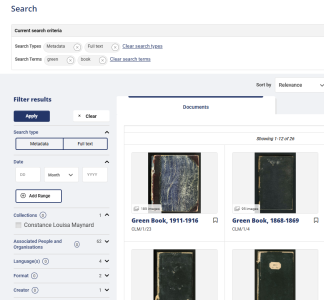
You can either use the browse function to look through all our digital content, or you can put a search term in the search bar (on the home page, or at the magnifying glass icon at the top of any page) and it will show results from documents (which might be the metadata - i.e. the information on an item’s document page - or the transcription) or static content (articles and introductions written to accompany the collections). The search results page will show you documents in which the search term appears:
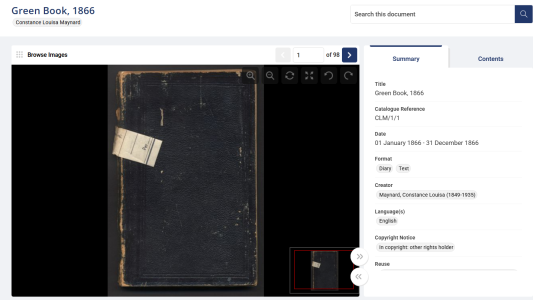
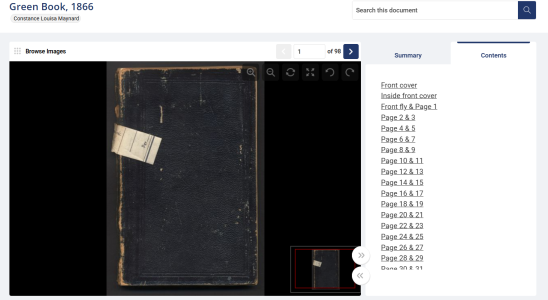
Click on a result to open it up and view the images, you can zoom in and out and move around the image to look at different parts in more detail. If the image comes from something divided into contents, for example the Green Books are divided up by page, you can navigate through these, either by clicking the forward and back arrows at the top right of the image, or jump to different pages via the 'Contents' tab in the information panel on the right:
Some of our items have been transcribed using OCR (Optical Character Recognition) or HTR (Handwritten Text Recognition). This is to aid full-text search and may not be 100% accurate.
The International Image Interoperability Framework is an open-source tool that is used by heritage institutions across the world. This can be used to view the document in full screen, and to compare it with other items in our collection or even from other institutions’ online collection platforms that support the IIIF viewer.
Finding more about our collections
The material on Queen Mary Digital Collections does not represent everything we hold in our collections. In many cases, a selection has been made, and more material is available for consultation in our Archives Reading Room. Some collection items will have a Catalogue Reference on their document page, which you can use to look them up in our Archive Catalogue to find out more about it and related items. For information on how to use the Archive Catalogue, see our Getting Started page for an introduction to the archives and tips on how to find material.
Help using this website
You can either use the browse function to look through all our digital content, or you can put a search term in the search bar (on the home page, or at the magnifying glass icon at the top of any page) and it will show results from documents (which might be the metadata - i.e. the information on an item’s document page - or the transcription) or static content (articles and introductions written to accompany the collections). The search results page will show you documents in which the search term appears:
Click on a result to open it up and view the images, you can zoom in and out and move around the image to look at different parts in more detail. If the image comes from something divided into contents, for example the Green Books are divided up by page, you can navigate through these, either by clicking the forward and back arrows at the top right of the image, or jump to different pages via the 'Contents' tab in the information panel on the right:
Some of our items have been transcribed using OCR (Optical Character Recognition) or HTR (Handwritten Text Recognition). This is to aid full-text search and may not be 100% accurate.
The International Image Interoperability Framework is an open-source tool that is used by heritage institutions across the world. This can be used to view the document in full screen, and to compare it with other items in our collection or even from other institutions’ online collection platforms that support the IIIF viewer.
Finding more about our collections
The material on Queen Mary Digital Collections does not represent everything we hold in our collections. In many cases, a selection has been made, and more material is available for consultation in our Archives Reading Room. Some collection items will have a Catalogue Reference on their document page, which you can use to look them up in our Archive Catalogue to find out more about it and related items. For information on how to use the Archive Catalogue, see our Getting Started page for an introduction to the archives and tips on how to find material.
Our aim in describing our collections is to make it as easy as possible for you to find relevant items. With this in mind we have taken a decision to use modern language in our tagging like current names of countries and subject terms like LGBTQ+. These tags are applied even if the item in question was created before a country was re-named or a term invented. This has been done to help with discovery and to group items into meaningful categories for today's users. We will review these on a yearly basis to check they remain accurate and relevant.
You will still find any historical terms or place names relevant in the description of the item so you can search by these terms. But if you want to filter by a subject or place you should look for the most recent version of this name/term.
In our "Associated People or Organisations" field we have used the most recent name of a given organisation or person that we know of. Maiden names and previous organisational names will remain in the item description so you can still search by these terms in free text search. But if you are trying to filter the collections for someone or something that changed their name you should use their most recent name when choosing a filter.
Describing our collections
Our aim in describing our collections is to make it as easy as possible for you to find relevant items. With this in mind we have taken a decision to use modern language in our tagging like current names of countries and subject terms like LGBTQ+. These tags are applied even if the item in question was created before a country was re-named or a term invented. This has been done to help with discovery and to group items into meaningful categories for today's users. We will review these on a yearly basis to check they remain accurate and relevant.
You will still find any historical terms or place names relevant in the description of the item so you can search by these terms. But if you want to filter by a subject or place you should look for the most recent version of this name/term.
In our "Associated People or Organisations" field we have used the most recent name of a given organisation or person that we know of. Maiden names and previous organisational names will remain in the item description so you can still search by these terms in free text search. But if you are trying to filter the collections for someone or something that changed their name you should use their most recent name when choosing a filter.
To support users who use screen readers to access our website and improve searching for everyone we aim to provide transcripts wherever possible of textual records made available on this website. These transcripts are first generated by HTR and OCR technology then manually checked by humans. Mistakes are still possible, so if you notice any feel free to let us know via our feedback form indicating which item and page the issue is in. We will then review, make any corrections as needed and let you know when the corrected transcript is available.
Where transcripts exist you will find them in a tab labelled transcript on the right hand side of the image. Some transcripts will be uncorrected HTR or OCR until we are able to complete our corrections and improvements. We don’t have transcripts available for all items available on this site. Checking and improving transcripts is an ongoing area of work. If you need a transcript to access an item and there is none currently available or you find it to be unusable without correction, we are open to requests for transcription on demand where we have the capacity. Please make these via our feedback form.
Our Practices
To enhance the experience of users who use screen readers we have added explanatory information and symbols to indicate stylistic choices in the original item. We have also made some changes to the original text in the transcript to make them easier to use for screen readers. A full explanation of any changes to expect between the original and the transcript and our policies for indicating particular stylistic choices is outlined alphabetically below.
Abbreviations
We expand abbreviations and acronyms whenever we can. If we have left an abbreviation or acronym, it is because we don't know what it means.
The expanded abbreviation/acronym will replace the abbreviation/acronym in the transcript. One exception is if a proper place name includes an abbreviation e.g. St Andrews; these will be transcribed as is.
Example
Original text reads “I wrote to the G.P.M.”. Transcript reads “I wrote to the Girton Prayer Meeting”.
Bible quotations
We expand the title of the book from the Bible if it is abbreviated. The expanded Book title will replace the abbreviation in the transcript.
Additionally, we will replace the full stops after each number which indicate a reference to a chapter and verse with the words "chapter" and "verse".
Example
Original text reads “Gen. 1.1”. Transcript reads “Genesis Chapter 1 Verse 1”.
Deleted text
We will indicate if text was intended to be removed.
We will do this by putting the text they indicate inside square brackets, quotation marks and describing the annotation used to indicate deletion.
Example
Original text reads “I was am”. Transcript reads “I [“was” crossed out] am”
Different authors
We will indicate if we suspect something was written by a different person than the primary author based on visual differences in handwriting and/or knowledge of the collection.
We use "different hand" to describe this. If we can identify the other author we would instead use their name.
Example
Original text reads “Today on my birthday ^she wrote this in 1933”. Transcript reads “Today on my birthday [“she wrote this in 1933” inserted in a different hand]”.
Emphasis
We indicate emphasis like underlining, circling, bold text and italicised text.
We will do this by adding a star before the emphasis begins and a star after the emphasis ends.
Example
Original text reads “I am so happy”. Transcript reads “I am *so* happy”.
Hyphenated words
We remove hyphens if they were added to a word split into two parts because it was written across two lines in the original. We write it as one word in the transcript.
Hyphens used for any other reason are transcribed as in the original.
Example
Original text reads “con-
viction.”
Transcript reads “conviction”.
Illegible text
We will indicate if we have been unable to read a word in the original text to provide a transcription.
We will do this by writing "illegible" in square brackets in place of the illegible word.
Example
Transcript reads “[illegible]”.
Inserted text
We will indicate if the creator added in a word or phrase later.
We will do this by writing the inserted text inside square brackets, quotation marks and using the word “inserted”. We will place the text where the author intended it to be inserted to a sentence.
Example
Original text reads “we travelled to Edinburgh ^Scotland”. Transcript reads “we travelled to Edinburgh [“Scotland” inserted].
Line breaks
We will not indicate where a new line is started because the writer reached the edge of the page in the transcript.
We will include line breaks used by the creator for any other reason.
Example
Original text reads "The
unremitting failure to achieve this "faith" that should do everything
in life, renew conduct & open Heaven, gave me a strong sense of sin."
Transcript reads "The unremitting failure to achieve this "faith" that should do everything in life, renew conduct & open Heaven, gave me a strong sense of sin."
Marginalia
Marginalia is annotation written outside the main text block with no indication it was intended to be inserted into the main text. We will include it at the end of a page of transcription.
We will place it inside square brackets, with a note reading “notes in the marginalia read” and in quotation marks. If it is a symbol we will describe it. We will describe the placement on the page if it has significance.
Example
Original text reads “1896. Mr. Anagnos.” Transcript reads “[Notes in the marginalia read, “1896” and “Mr Anagnos”]
Nicknames
We will transcribe nicknames as they appear in the original. The full name of a person may be provided inside square brackets afterwards. This is done if the transcript editor deemed it necessary for understanding and they know who the person is.
Example
Original text reads “Consy”. Transcript reads “Consy [Constance Maynard]”.
Spelling and grammar
We will transcribe spelling and grammatical mistakes as they appear in the original. A correction may be provided inside square brackets afterwards. This is done if the transcript editor deemed it necessary for understanding.
Example
Original text reads “disapointing”. Transcript reads “disapointing [disappointing]”.
Transcription practices
To support users who use screen readers to access our website and improve searching for everyone we aim to provide transcripts wherever possible of textual records made available on this website. These transcripts are first generated by HTR and OCR technology then manually checked by humans. Mistakes are still possible, so if you notice any feel free to let us know via our feedback form indicating which item and page the issue is in. We will then review, make any corrections as needed and let you know when the corrected transcript is available.
Where transcripts exist you will find them in a tab labelled transcript on the right hand side of the image. Some transcripts will be uncorrected HTR or OCR until we are able to complete our corrections and improvements. We don’t have transcripts available for all items available on this site. Checking and improving transcripts is an ongoing area of work. If you need a transcript to access an item and there is none currently available or you find it to be unusable without correction, we are open to requests for transcription on demand where we have the capacity. Please make these via our feedback form.
Our Practices
To enhance the experience of users who use screen readers we have added explanatory information and symbols to indicate stylistic choices in the original item. We have also made some changes to the original text in the transcript to make them easier to use for screen readers. A full explanation of any changes to expect between the original and the transcript and our policies for indicating particular stylistic choices is outlined alphabetically below.
Abbreviations
We expand abbreviations and acronyms whenever we can. If we have left an abbreviation or acronym, it is because we don't know what it means.
The expanded abbreviation/acronym will replace the abbreviation/acronym in the transcript. One exception is if a proper place name includes an abbreviation e.g. St Andrews; these will be transcribed as is.
Example
Original text reads “I wrote to the G.P.M.”. Transcript reads “I wrote to the Girton Prayer Meeting”.
Bible quotations
We expand the title of the book from the Bible if it is abbreviated. The expanded Book title will replace the abbreviation in the transcript.
Additionally, we will replace the full stops after each number which indicate a reference to a chapter and verse with the words "chapter" and "verse".
Example
Original text reads “Gen. 1.1”. Transcript reads “Genesis Chapter 1 Verse 1”.
Deleted text
We will indicate if text was intended to be removed.
We will do this by putting the text they indicate inside square brackets, quotation marks and describing the annotation used to indicate deletion.
Example
Original text reads “I was am”. Transcript reads “I [“was” crossed out] am”
Different authors
We will indicate if we suspect something was written by a different person than the primary author based on visual differences in handwriting and/or knowledge of the collection.
We use "different hand" to describe this. If we can identify the other author we would instead use their name.
Example
Original text reads “Today on my birthday ^she wrote this in 1933”. Transcript reads “Today on my birthday [“she wrote this in 1933” inserted in a different hand]”.
Emphasis
We indicate emphasis like underlining, circling, bold text and italicised text.
We will do this by adding a star before the emphasis begins and a star after the emphasis ends.
Example
Original text reads “I am so happy”. Transcript reads “I am *so* happy”.
Hyphenated words
We remove hyphens if they were added to a word split into two parts because it was written across two lines in the original. We write it as one word in the transcript.
Hyphens used for any other reason are transcribed as in the original.
Example
Original text reads “con-
viction.”
Transcript reads “conviction”.
Illegible text
We will indicate if we have been unable to read a word in the original text to provide a transcription.
We will do this by writing "illegible" in square brackets in place of the illegible word.
Example
Transcript reads “[illegible]”.
Inserted text
We will indicate if the creator added in a word or phrase later.
We will do this by writing the inserted text inside square brackets, quotation marks and using the word “inserted”. We will place the text where the author intended it to be inserted to a sentence.
Example
Original text reads “we travelled to Edinburgh ^Scotland”. Transcript reads “we travelled to Edinburgh [“Scotland” inserted].
Line breaks
We will not indicate where a new line is started because the writer reached the edge of the page in the transcript.
We will include line breaks used by the creator for any other reason.
Example
Original text reads "The
unremitting failure to achieve this "faith" that should do everything
in life, renew conduct & open Heaven, gave me a strong sense of sin."
Transcript reads "The unremitting failure to achieve this "faith" that should do everything in life, renew conduct & open Heaven, gave me a strong sense of sin."
Marginalia
Marginalia is annotation written outside the main text block with no indication it was intended to be inserted into the main text. We will include it at the end of a page of transcription.
We will place it inside square brackets, with a note reading “notes in the marginalia read” and in quotation marks. If it is a symbol we will describe it. We will describe the placement on the page if it has significance.
Example
Original text reads “1896. Mr. Anagnos.” Transcript reads “[Notes in the marginalia read, “1896” and “Mr Anagnos”]
Nicknames
We will transcribe nicknames as they appear in the original. The full name of a person may be provided inside square brackets afterwards. This is done if the transcript editor deemed it necessary for understanding and they know who the person is.
Example
Original text reads “Consy”. Transcript reads “Consy [Constance Maynard]”.
Spelling and grammar
We will transcribe spelling and grammatical mistakes as they appear in the original. A correction may be provided inside square brackets afterwards. This is done if the transcript editor deemed it necessary for understanding.
Example
Original text reads “disapointing”. Transcript reads “disapointing [disappointing]”.
What you might encounter
You may encounter content that is: ableist, classist, colonialist, homophobic, misogynistic, racist, transphobic, or xenophobic. Usually, this will take the form of outdated terminology or attitudes in historical material, but occasionally more contemporary material may also contain discriminatory views. If an offensive word is used in the original historical item and we provide a transcript for that item it will also appear in the transcription so visually impaired users can have an equitable experience. We understand that what constitutes harmful content is not necessarily the same for everyone and that you may access potentially harmful material that we do not yet know about.
Why we provide access
We collect, preserve and provide access to material to facilitate teaching, learning and research at Queen Mary and beyond. We do not exclude material because of the ideas or opinions expressed within it. The collections we make available may include biased or offensive language or reveal attitudes that reflect the views of their creators and/or the period in which they were created. We seek to balance the preservation of this history with sensitivity to how these materials are presented and perceived. The presence of any such material within our collections does not imply an endorsement of the ideas or opinions expressed within the content.
What we’re doing to address it
We strive to manage our collections responsibly and will take measures to minimise offence where appropriate. This does not mean we will alter original material or necessarily remove collections from public access. We will try to describe material respectfully and inclusively and if we know harmful content exists within a collection, we will use plain language to inform users about it and/or place an advisory warning on groups of records, to prepare researchers for the possibility that they might encounter content they find offensive.
If you encounter material that potentially could be considered harmful on Queen Mary Digital Collections, please contact us so we can use your feedback to help us provide an informed and supportive access experience.
Harmful content
What you might encounter
You may encounter content that is: ableist, classist, colonialist, homophobic, misogynistic, racist, transphobic, or xenophobic. Usually, this will take the form of outdated terminology or attitudes in historical material, but occasionally more contemporary material may also contain discriminatory views. If an offensive word is used in the original historical item and we provide a transcript for that item it will also appear in the transcription so visually impaired users can have an equitable experience. We understand that what constitutes harmful content is not necessarily the same for everyone and that you may access potentially harmful material that we do not yet know about.
Why we provide access
We collect, preserve and provide access to material to facilitate teaching, learning and research at Queen Mary and beyond. We do not exclude material because of the ideas or opinions expressed within it. The collections we make available may include biased or offensive language or reveal attitudes that reflect the views of their creators and/or the period in which they were created. We seek to balance the preservation of this history with sensitivity to how these materials are presented and perceived. The presence of any such material within our collections does not imply an endorsement of the ideas or opinions expressed within the content.
What we’re doing to address it
We strive to manage our collections responsibly and will take measures to minimise offence where appropriate. This does not mean we will alter original material or necessarily remove collections from public access. We will try to describe material respectfully and inclusively and if we know harmful content exists within a collection, we will use plain language to inform users about it and/or place an advisory warning on groups of records, to prepare researchers for the possibility that they might encounter content they find offensive.
If you encounter material that potentially could be considered harmful on Queen Mary Digital Collections, please contact us so we can use your feedback to help us provide an informed and supportive access experience.
Rights statements you will see on images in Queen Mary Digital Collections:
- In Copyright - you must get permission from the rights holder to reuse it beyond permitted exceptions.
- No Known Copyright / Out of Copyright - you are free to reuse this so long as you are satisfied by your own assessment.
Licences you will see on Queen Mary Digital Collections. These enable reuse of in copyright material so long as you follow the outlined conditions:
Quotation with proper attribution is a copyright exception and is therefore allowed for any collection published here. To cite your quote please include the following: Queen Mary University of London Archives: Collection name; Catalogue reference; Title, date, page or item number. This information can be found in the summary fields of an item.
Copyright and re-use
Rights statements you will see on images in Queen Mary Digital Collections:
- In Copyright - you must get permission from the rights holder to reuse it beyond permitted exceptions.
- No Known Copyright / Out of Copyright - you are free to reuse this so long as you are satisfied by your own assessment.
Licences you will see on Queen Mary Digital Collections. These enable reuse of in copyright material so long as you follow the outlined conditions:
Quotation with proper attribution is a copyright exception and is therefore allowed for any collection published here. To cite your quote please include the following: Queen Mary University of London Archives: Collection name; Catalogue reference; Title, date, page or item number. This information can be found in the summary fields of an item.
In cases where our digitised collections have third party rights holders, we have made every reasonable effort to contact them to gain permission before publishing on Queen Mary Digital Collections. However, in cases where we have been unable to identify who these rights holders are or find current contact details after making all reasonable efforts to find these we have taken the decision to publish anyway. This is because we believe the public good of making information accessible for educational and research purposes justifies this approach.
If you are a rights holder and you are concerned that you have found material available on Queen Mary Digital Collections which you have not given permission to be published, which infringes your copyright and is not covered by a limitation or exception in national law, please contact us in writing stating the following:
- Your contact details
- The nature of your request
- Full details of the material concerned including URL and catalogue reference where available
- Proof that you are the rights holder or are an authorised representative
Once we receive your request the takedown procedure is as follows:
- We will acknowledge your correspondence within 10 working days
- We will make an initial assessment of the validity of the request, considering the material’s copyright status and verifying your identity as the copyright holder, and if the complaint is found to be valid, we will temporarily remove the material from Queen Mary Digital Collections until we can reach an agreed solution
We will aim to resolve the issue swiftly and amicably and to the satisfaction of both parties, with the following possible outcomes:
- The material is replaced on the website unchanged.
- The material is replaced on the website with changes.
- The material is permanently removed from the website.
We aim to resolve issues within 20 working days from the date we acknowledge your takedown request.
Takedown procedure
In cases where our digitised collections have third party rights holders, we have made every reasonable effort to contact them to gain permission before publishing on Queen Mary Digital Collections. However, in cases where we have been unable to identify who these rights holders are or find current contact details after making all reasonable efforts to find these we have taken the decision to publish anyway. This is because we believe the public good of making information accessible for educational and research purposes justifies this approach.
If you are a rights holder and you are concerned that you have found material available on Queen Mary Digital Collections which you have not given permission to be published, which infringes your copyright and is not covered by a limitation or exception in national law, please contact us in writing stating the following:
- Your contact details
- The nature of your request
- Full details of the material concerned including URL and catalogue reference where available
- Proof that you are the rights holder or are an authorised representative
Once we receive your request the takedown procedure is as follows:
- We will acknowledge your correspondence within 10 working days
- We will make an initial assessment of the validity of the request, considering the material’s copyright status and verifying your identity as the copyright holder, and if the complaint is found to be valid, we will temporarily remove the material from Queen Mary Digital Collections until we can reach an agreed solution
We will aim to resolve the issue swiftly and amicably and to the satisfaction of both parties, with the following possible outcomes:
- The material is replaced on the website unchanged.
- The material is replaced on the website with changes.
- The material is permanently removed from the website.
We aim to resolve issues within 20 working days from the date we acknowledge your takedown request.